Posted by AAA Metals Company on | Comments Off on Tariffs and Price Volatility in 304 and 316 Stainless Steel
In early summer 2025, the US federal government doubled Section 232 tariffs on steel and aluminum imports from 25% to 50%, with the duty increase taking effect on June 4. This decision proved controversial and drew concern from many experts in the industry, as worries grew about the effects of higher tariffs on stainless steel prices and supply chains in general.
The cited concerns included shortages of specialty metals, drastic lead time increases, price volatility, and higher consumer prices.
This situation left many wondering what these tariffs will mean for stainless steel supply and pricing in the coming months. Keep reading to learn more about how the 232 tariffs are playing out in the stainless steel supply chain.
How Tariffs Affect the Domestic Stainless Supply Chain
While the goal of increasing the 232 tariffs was to protect the domestic stainless steel industry, they also create several challenges for the domestic stainless steel supply. This is because imported stainless steel accounts for upwards of 30% of the US stainless steel market, as domestic production is often insufficient to meet market demand. As it relates to hexagon, flat bar, and square bar, nearly 100% is imported. Domestic distributors have been significantly affected by tariffs that make their products expensive to buy, and very challenging for them to sell. Domestic manufacturers are not picking up the slack in supply.
The tariff increases have already resulted in some suppliers canceling stainless steel import orders, which then limits supply as domestic manufacturers are unable to keep up with demand. What’s more it takes time for domestic production to ramp up enough to make up the difference. This could lead to supply struggles in the near future.
The Link Between 232 Tariffs and Alloy Pricing
Supply limitations could also have a significant impact on the 304 and 316 stainless price and the cost of other stainless grades for end consumers because as imported stainless steel prices rise, suppliers generally pass tariff costs on to manufacturers and other buyers of raw materials. As less steel is imported, demand for domestic steel will rise, further increasing its price. Furthermore, with reduced competition from imported steel, domestic stainless steel prices could go up as well. All of these factors point to higher prices throughout the supply chain and manufacturing process, with the final result of higher prices for consumers and end-users of products made with stainless steel. Where a high percentage of supply in certain products is mainly imported, there will likely be shortages.
304 and 316 Stainless Steel- Cost and Sourcing Challenges
The supply chain and cost implications of the 232 steel tariffs depend greatly on the type of stainless steel required. Some favored grades of stainless steel, like 304/316 stainless steel, had an oversupply ahead of the tariffs, meaning that most buyers will not face shortage risks or extreme price volatility for this grade in the immediate future.
One way domestic producers may try to meet growing demand for stainless steel is to prioritize favored grades like 304 and 316.
The downside to this approach is that if domestic production focuses on certain, more common stainless steel grades, the supply of other less common grades could dwindle, leading to sourcing challenges and significant price volatility.
Regional Supply Constraints and Lead Time Impacts
The extent to which the stainless steel supply chain will be impacted by 232 tariffs will ultimately depend on where suppliers and buys are located geographically. This is because tariffs can shift the flow of goods to specific regions as the supply chain reacts to changing global trade dynamics. Shortages and price volatility in specific regions could result in significant lead times for some buyers but not as much for others.
Other Factors Influencing Pricing
Although most experts agree that pricing is affected by all these factors, many have warned about the practice of price gouging. Some of the larger distributors with inventory have been able to leverage the tariffs for higher profits using these methods.
How AAA Metals Mitigates Tariff Volatility
Given the supply chain challenges that the increase in 232 tariffs could cause, it’s essential to partner with a reliable stainless steel supplier. AAA Metals has been a trusted distributor of consistently high-quality stainless steel, superior nickel alloy, titanium and hard to find metals since 1978. Our team has the experience to source high-quality metals during these uncertain times. With a vetted industry network and partnerships, we help buyers mitigate the Section 232 impact with stable sourcing amid these tariff shifts.
AAA Metals has been able to mitigate some of the high costs incurred through tariffs by employing highly efficient processing techniques.
Please request a quote for more information about our stainless steel stock products and material options.
Posted by AAA Metals Company on | Comments Off on The Hidden Risks in U.S. Mill Quality Control
The quality of stainless steel begins in production mills, where the integrity of the raw material significantly impacts properties and performance characteristics of the finished product or application. As the supply chain for specialty alloys becomes increasingly complex, the systems that are supposed to guarantee quality control are often unable to keep pace. This creates risks that may not be obvious until parts or structures fail.
The Real Consequences of QA/QC Lapses
Quality assurance managers and procurement specialists often rely on a Mill Test Report (MTR) to verify stainless steel quality. Unfortunately, this can be a high-risk strategy because these reports do not take into account the possibility of human error or supply chain mistakes.
For instance, suppose that a fabricator needs stainless steel to make pressure vessels. If a mill supplies out-of-spec stainless steel, meaning it does not meet requirements for composition, mechanical, or physical properties, there is a risk that it could have a tensile strength far below what it should. Panels made from it could crack during assembly, or other problems could arise downstream.
In this example, the underlying cause of the problem could result from poor process control in the mill, where hardness testing was skipped or performed improperly on several batches. This unexpected QA/QC lapse can result in lost production, delayed delivery, and costly re-fabrication.
Common Failures in Domestic Stainless Steel Mill Production
Stainless steel is made from blends of iron, scrap steel, nickel, chromium, and other metals. They are mixed in different ratios depending on the specific grade being manufactured, then melted in a furnace. Once molten, the mixture is refined to adjust the composition, ensure consistent distribution, and remove impurities. Then it is rolled or formed into sheets or shapes (e.g., bars, rods), annealed, and descaled.
Throughout the stainless steel manufacturing process there are many opportunities for errors that can result in stainless steel that doesn’t meet the chemical or physical properties required for the particular grade:
Reduced corrosion resistance.
Pitting.
Hardness variations.
Intergranular corrosion.
Galvanic corrosion.
Reduced tensile strength.
Inconsistent alloy chemistry.
How Insufficient Quality Control Impacts Fabrication and End Users
Quality control is critical to producing high-quality stainless steel that has the chemical and physical properties and performance characteristics it’s expected to have. When QC processes are not well-defined, implemented, or followed consistently, the chances of producing bad or out-of-spec batches increase. In turn, products and parts made with these subpar materials may be harder to fabricate, prone to failure or weakness, less durable, or unreliable.
In addition to poor quality control in manufacturing the steel itself, problems like mislabeling, rough or imprecise cutting, poor polishing, or excessive scratches or dents in sheets and forms lower material quality.
Poor polishing, in particular, can result in germs and other contaminants leading to pre-mature failure, rust and corrosion.
Stainless steel quality control affects every point along the value chain. When procedures are not followed and substandard materials are distributed, the entire value chain is impacted:
Fabricators: Welding failures, cracking, poor aesthetics, re-orders to replace damaged raw material, product or part failures, premature corrosion.
Finished product end-users/consumers: Unreliable parts, shorter-than-expected equipment lifespan, increased maintenance, frequent or early replacement.
AAA Metals’ Internal Inspection & Verification Process
At AAA Metals, we understand how the quality of stainless steel and the quality control process is to stainless steel production as well as to downstream fabrication and products. We work with a network of vetted distributors and take additional steps to require and verify stringent inspection standards.
Testing
We verify that the following QA/QC tests have been performed for chemical, mechanical, and performance standards as required:
Corrosion testing.
Eddy-current or ultrasonic testing.
Hardness measurement.
Spectrochemical analysis.
Melt and heat-trace verification.
Microstructure examination.
Surface finish inspection.
Tensile and yield testing.
Certification
Stainless steel is certified before it is released from the mill to verify that its production has followed ISO-aligned quality standards. AAA Metals confirms the following data:
Documented compliance with ASME/ASTM standards.
Validated Material Test Reports (MTRs).
Verified mechanical and chemical properties.
Traceability
By supplying traceable stainless steel, AAA Metals ensures all materials can be connected back to their origins, tracking the full chain of custody and verifying compliance at every stage. Essential requirements for incoming material verification include:
Compliance with ASME/ASTM marking rules.
Confirmation of heat numbers and chemical properties.
Documented MTR.
Material grade assessment.
Contact AAA Metals For Reliable Quality and Service Today!
Since 1978, AAA Metals Company, Inc. has been a distributor of stainless steel, nickel alloys, titanium, and many hard-to-find metals. We place high value on quality control and inspection in order to provide our customers with highest quality stainless steel and other alloys with every order. One of our biggest goals is to provide innovative solutions that help customers avoid costly mill errors and non-conforming metals
Our products include bars, plates, rings, discs, forgings, pipe, and tubing from stock, in mill form, polished, or in precision cut pieces. Value-added services include laser and waterjet cutting, sawing, and shearing. We also specialize in stainless steel polishing including face, edge, and outside diameter polishing and can achieve 180 grit through Ra finishes to meet your requirements.
Posted by AAA Metals Company on | Comments Off on The True Cost of Imported Stainless Steel
A cheap procurement price can be tempting for manufacturers that need to produce goods and assemblies at a certain price point to optimize operating costs. But low quotes on imported stainless steel don’t always tell the whole story. Not only can they fail to disclose direct fees and associated costs, but they also don’t show the extra costs that can pile up from delays, tariffs, and general turbulence at the docks.
Understanding the total cost of ownership (TCO) for obtaining stainless steel from different sources helps businesses understand the full price they will pay and more clearly compare supplier options. At AAA Metals, we provide transparent pricing details so our customers can calculate costs using the TCO approach and evaluate all of their potential vendors on equal grounds.
Why Import Quotes Often Hide Real Costs
A common procurement mistake in the stainless steel market is not understanding the full cost of buying materials from different sources. A domestic stainless steel fabricator in the local region, state, or county may have a higher per unit price, which seems high compared to a lower per unit price for imported materials. However, the import sticker price does not include transportation costs, administrative costs, and the added cost of potentially broken pieces and poor quality. Inexpensive imported metals always carry extra costs that are rarely disclosed up front. Many suppliers do this because they compete based on unit price, and by hiding the total cost, it’s easier to win bids and then force the incidental costs onto customers that don’t have the time or bandwidth to pursue backup suppliers.
Freight, Delays, and Communication Barriers
What exactly are the costs that import quotes don’t disclose? Consider these:
Direct freight costs.
Administrative and freight management costs for handling customs and proper import regulations.
Transportation for moving stainless steel stock from the docks to the customer’s location.
The direct and indirect costs of delays, such as emergency purchases with backup vendors, returns and potential penalties to downstream producers and clients, and the reputational cost of being considered unreliable.
Logistical frustrations due to language barriers, different import regulations, and time zone differences.
Some of these costs are directly quantifiable but won’t be visible on your quote. Other costs are high-likelihood risks that will eat through your budget if delays or disasters strike.
The TCO Approach to Sourcing Metals
Switching from comparing quotes directly to a TCO approach makes it easier to see all of the costs incurred when sourcing and importing materials. The TCO for stainless steel encompasses
tariffs, logistics expenses, quality control expenses, additional inventory needed to cover damaged and lost goods, and initial acquisition costs, on top of the price of the material itself.
This total cost is a better number for comparing the price of imported goods against domestic suppliers of stainless steel stock.
How Quality and Traceability Save Money Long-Term
Imports often come with risks that are hard to calculate, including data theft, delays, supply chain volatility, and material quality deficits. If quality control measures are poorly defined or unenforced, or if material origins are not traceable, it’s difficult or impossible to verify the quality and source of the order. Conversely, domestic stainless steel sources often have quality control measures and traceability standards compliance built into the price.
For example, at AAA Metals, we meet AMS, QQ-S, ASTM, ASME, and MIL-S standards and specifications through our worldwide sourcing and distribution network. This means our customers don’t have to worry about poor quality, non-compliant materials or scrambling to find appropriate stock from backup suppliers.
AAA Metals vs. Importers—A Cost Case Comparison
When sourcing stainless steel and other materials, it’s critical to understand total acquisition costs in order to make an informed comparison and buying decision. All-inclusive pricing from a trusted metal supplier like AAA Metals makes it easier to see how much materials truly cost as well as their true value. Many importers will offer quotes with simply the material price, which doesn’t include the expense of hiring a licensed customs broker and working with freight forwarders. There is also no clear insight into the tariffs, especially if there is a lack of transparency surrounding the first sale price versus the resale price.
At AAA Metals, we make it easy for our customers to find high-quality stainless steel with a transparent price point. We supply raw materials in many forms including bars, plates, rings, discs, forgings, pipe and tubing as well as polished or in precision cut pieces.
Contact us today to get a detailed quote for stainless steel, nickel alloy, titanium, and more.
Posted by AAA Metals Company on | Comments Off on Surface Preparation For Final Polish
Surface preparation in stainless plate fabrication for semiconductor tooling and microchip equipment requires polishing. When measuring the surface, AAA Metals Co., Inc. utilizes several different techniques to achieve precise surface measurements.
Why Surface Finish Matters in Semiconductor Equipment
Surface finishes play an essential role in the performance, yield, and quality of machine parts used in semiconductor manufacturing. As technology becomes smaller and more advanced, the specifications of a silicon wafer have become stricter.
The following surface parameters must be taken into consideration:
Uniformity
Smoothness
Absence of irregularities
The Connection Between Surface Integrity and Yield
Surface specifications must meet stringent requirements to promote the highest level of reliability, performance, and quality.
The surface integrity must be maintained during every step of the fabrication process to allow for the highest yield rates while delivering:
Accurate focus
Dimension control
Uniform layer thickness
These properties are essential for manufacturing high-density circuits, advanced semiconductor components (such as memory chips and microprocessors), and machine parts used in semiconductor manufacturing. They are also critical for producing solar cells, integrated circuits, and other photonic and electronic devices.
Accurate measurements including surface finish requirements assure optimal quality control.
Finishing Methods Used To Achieve Results
Various stainless steel polishing, metrology, and grinding methods can be used to achieve and maintain desired specifications, such as:
Dimensional testing. Measures and verifies the geometric properties of machine parts to ensure they meet tight tolerance and design specifications.
Mechanical grinding. A rotating wheel removes excess material to prepare, shape, or finish a surface with high precision.
Stainless steel polishing. Smooths the surfaces of angles, pipes, sheets, and other fabricated metal pieces, providing a final corrosion-resistant finish.
AAA Metals’ Standards and Verification Methods
At AAA Metals Company, Inc., we conduct dimensional and visual inspections and surface testing to verify surface precision and product quality. We adhere to all ASTM standards, ensuring our products meet exact requirements for the application.
Improving Yield Reliability Through Accurate Surface Measurement
Creating stainless plates requires precision polishing and accurate surface measurements to improve yield reliability. As a full-service supplier of stainless and superior alloys, AAA Metals Company, Inc. is your trusted partner for semiconductor fabrication, and we have the capabilities to provide high-quality products that meet or exceed our customers’ expectations.
We carry a large inventory of metal stock and offer a broad range of polishing, finishing, and value-added services. Our products meet the tightest tolerance requirements and are accurately measured to ensure surface finish.
Contact us or request a quote today to learn more about our products and services and see how our experienced team can help you select stainless plates that match your exact specifications.
Posted by AAA Metals Company on | Comments Off on 300 vs. 400 Series Stainless Steel: A Comprehensive Comparison
Stainless steel comes in many grades to meet the unique requirements of their intended application. The most common families of stainless steel are 300 and 400 series stainless steel. These grades can be cut into specific shapes and sizes and finished according to your project’s needs. AAA Metals distributes 300 series, 400 series, and other stainless steel grades, as well as titanium, nickel alloys, and hard-to-find metals. We serve numerous industries with our high-quality alloys, including the aerospace, chemical, marine, packaging, and pharmaceutical sectors.
Read on to learn more about the benefits of 300 and 400 series stainless steel, their respective chemical compositions, and their common applications.
Understanding the 300 and 400 Series
Depending on the performance requirements of your project, various grades of stainless steel are available to meet these needs. If it requires durability, 300 series and 400 series stainless steel are preferred choices.
300 series stainless steel (SS 300) is the most popular type, offering excellent corrosion resistance and non-magnetic properties due to its higher nickel content. 400 series stainless steel (SS 400) contains less nickel than SS 300, but it offers improved abrasion resistance and toughness compared to SS 300. However, SS 400 can be more susceptible to oxidation and rust under certain environmental conditions.
To compare the benefits of 300 and 400 series stainless steel side by side, see the following key characteristics:
300 Series Stainless Steel:
Exceptional machinability
Austenitic crystalline structure with non-magnetic properties
High-temperature resistance
Multiple finishing options
Simple maintenance
Crack, scratch, and etch resistance
Resistance to thermal shock
High creep resistance
Resistance to carburizing and nitriding
400 Series Stainless Steel:
Improved strength compared to carbon steel
Martensitic crystalline structure with magnetic properties
Various surface finishing options
Not hardenable with heat treatment
A sustainable option for applications requiring thin, lightweight materials
Resistance to high-temperature scaling
Chemical Composition and Properties
The chemical composition of stainless steel is primarily iron with a chromium content of 10.5% or more. The chromium content allows every grade of stainless steel to develop a passive chromium oxide layer on its surface, providing excellent resistance to corrosion.
300 series stainless steel has a chemical composition of iron, nickel, 16-26% chromium, 2% manganese, up to 4% molybdenum, and trace amounts of other elements. 400 series stainless steel is typically composed of iron, 11-27% chromium, around 1% manganese, and trace amounts of other elements. SS 400 has a higher carbon content than SS 300.
Common Applications of Each Series
300 and 400 series stainless steel offer a suitable solution for numerous applications. Some of the common industries and applications where grades of 300 series stainless steel are used include:
303 Stainless Steel: aerospace nuts, gears, bolts, and fittings
304 Stainless Steel: shipping, food and beverage, nuclear, and automotive industries
304L Stainless Steel: welding applications
316 Stainless Steel: marine and nuclear applications
316L Stainless Steel: chemical and pharmaceutical industries
Specific grades of 400 series stainless steel are ideal for the following applications:
440C Stainless Steel: bearings, surgical instruments, and nozzles
Contact AAA Metals for Custom Stainless Steel Solutions
300 and 400 series stainless steel grades offer excellent durability and resistance to corrosion for most applications, from stainless steel fittings to gears to surgical instruments. AAA Metals can help you select the ideal stainless steel grade for your application. We have over 40 years of experience in the metals industry serving customers with prompt delivery, quality materials, and competitive pricing. We supply raw materials in plate, bar, ring, disc, pipe, tubing, and other forms and can polish or precision-cut them to your specifications.
Posted by AAA Metals Company on | Comments Off on How to Improve Corrosion Resistance in Polished Stainless Steel
Stainless steel is widely used in a range of industries, including aerospace, manufacturing, food processing, and marine applications. Steel materials like 304 stainless steel are popular in a range of industries, thanks to their impressive corrosion resistance and durability. However, stainless steel can still become susceptible to the effects of harsh operating environments.
Various techniques can be used to reduce the risk of corrosion damage and achieve the desired surface finish in polished stainless steel. Below, we’ll discuss the critical role corrosion resistance plays in various stainless steel finishing techniques and how each works to protect steel parts.
Importance of Corrosion Resistance in Polished Stainless Steel
Corrosion resistance is critical for high-performing stainless steel components, particularly those that must perform in aggressive environments such as offshore or nuclear industries. Properly polished stainless steel surfaces are much less likely to experience localized corrosion or accumulate deposits than rough or badly polished surfaces, resulting in improved performance over the component’s service life. The right finish can also improve consistency and the overall look of stainless steel parts.
How to Improve Corrosion Resistance in Polished Stainless Steel
There are several major ways professionals can improve corrosion resistance in polished stainless steel. Consider the following options for protecting stainless steel components:
Passivation
Passivation is an essential chemical treatment for enhancing corrosion resistance in stainless steel components. Passivation uses an acidic or alkaline solution to form a thin layer of chromium oxide (Cr203) on metal surfaces. This passive film prevents rust from forming in harsh operating environments.
Electropolishing
Electropolishing is widely used to deliver a corrosion-resistant surface in stainless steel and other metal alloy forms. This electrochemical process involves placing metal goods in an electrolytic bath and applying a current to remove extraneous surface material, including iron residue. This prevents chemical reactions that can lead to corrosion while creating a smooth, even finish.
Mechanical Polishing
This traditional finishing method works mechanically instead of chemically to make surfaces visibly smoother. Mechanical polishing uses abrasives to remove scratches, stains, and other irregularities from stainless steel surfaces. Manufacturers can also use sandpaper to polish surfaces. Mechanical polishing is useful for focusing on specific areas. However, it can be time-consuming and requires skill to effectively implement.
Regular Cleaning and Maintenance
Ongoing maintenance can help keep polished stainless steel goods in top condition. Regular cleaning can remove dirt and chemicals that build up over time. Additionally, inspecting surfaces during cleaning can reveal early signs of corrosion.
Coating Protection
Applying special coatings onto stainless steel surfaces can offer added protection in highly corrosive environments. Common coating options include:
Powder coating
Metal plating
Painting
Each one offers unique advantages in terms of durability, cost-effectiveness, and overall protection.
Protect Your Stainless Steel Parts With Services Built to Block Corrosion
While finishing processes can vary by application, stainless steel components consistently benefit from improved corrosion resistance. At AAA Metals, we provide in-depth stainless steel polishing services for long-lasting protection. Depending on your needs, we can provide a more comprehensive solution, including converting materials, finishing manufactured pieces, and delivering completed orders to your distribution center or warehouse.
Handrails provide safety, structure, and aesthetic elements for walkways, stairways, platforms, and passageways. They are used in recreational, commercial, industrial, and residential settings. Flat metal bar stock is a popular choice for handrails, and it is available in many materials, widths, thicknesses, and lengths.
AAA Metals supplies a range of bar stock materials for flat bar handrail applications, along with grinding, polishing, and finishing capabilities to meet your requirements.
Posted by AAA Metals Company on | Comments Off on Bollards
What Are Bollards?
Bollards are solid vertical posts in front of buildings or structures that protect against vehicle collisions and other forces that can cause damage. They are installed on storefronts, sidewalks, trailheads, parking lots, and more. In addition to protecting buildings, occupants, and passersby against collisions, bollards are also used to control traffic and guide pedestrians.
Types of Bollards
Bollard posts can be categorized based on their intended application. Depending on how they are installed and if they can be removed, bollards can be permanent or temporary. Here are the most common types of bollards, each one designed for specific purposes:
Street or Traffic Line Bollards: These bollards are usually installed on streets, public squares, or sidewalks to demarcate vehicle, bike, and foot traffic. They can also prevent access to restricted areas in these public spaces.
Pedestrian Bollards: These are used specifically to guide pedestrian traffic and separate them from vehicles. They’re also used in visually defining property perimeters while adding aesthetic flair. Pedestrian bollards can be lighted to illuminate a walkway at night.
Construction Bollards: You’ll find these bollards in construction zones, where they limit or guide vehicle traffic to protect workers, pedestrians, and drivers from construction hazards.
Ram-Raid Bollards: These are installed around shops and other commercial buildings to prevent ram raids, a type of “smash and grab” burglary where a vehicle crashes through the doors or windows of a store while thieves loot products. Ram-raid bollards can withstand vehicle collisions and help deter ram-raiding.
How Metal Bollards Are Made
A metal bollard is made by rolling sheet metal into a pole-like shape and fitting or welding the top, which can be domed, flush, or open. Then the bollard is polished or powder-coated for the desired finish. Below are some of the common metal materials, finishes, and sizes used in making bollard poles.
Common Bollard Materials
The specific metal used in making a bollard depends on its need or functionality—where and how it’s going to be used. Our most common materials for bollards include:
Stainless steel
Grade 304
Grade 316
Bollard Finishes
Bollard posts are finished in a variety of ways, such as:
Stainless Steel Polishing: Polished stainless steel bollards offer a clean, modern look that also provides more hardness and corrosion resistance than mild steel.
At AAA Metals, we usually polish bollards to a #4 or Scotch Brite finish, but we can customize this based on our customers’ desired finish.
Common Sizes
Bollard poles come in various sizes, but the most common outer diameter sizes include:
4.5 inches
6.625 inches
8.625 inches
AAA Metals can also produce custom bollard diameters and heights based on our customers’ unique specifications.
Bollards come in different types and materials for different needs, so you can customize them based on your unique specifications. For high-quality metal bollards, turn to the experts at AAA Metals. Our bollards meet all applicable industry standards and can provide robust, long-lasting protection for your building or other structure. We specialize in fabricating high-quality tubes and pipes, meeting ASTM, AMS, ASME, Mil-Spec, and QQS standards as needed.
Posted by AAA Metals Company on | Comments Off on Polishing for Food Grade Stainless Steel
Stainless steel components for the food processing industry must be strong, durable, non-reactive, and smooth. These qualities enable the material to stand up to the rigors of food handling, processing, and preparation. In particular, smooth finishes on stainless steel are vital to maintaining safe and sanitary conditions by preventing the buildup of debris and bacteria on the surface. Experienced suppliers with specialized knowledge are best equipped to polish stainless steel to meet these critical hygiene and performance requirements.
Learn more about the stainless steel polishing process, types of finishes, types of polishing, and more.
Stainless Steel Polishing
Polishing stainless steel is an important finishing step that can improve both aesthetic and functional qualities of many products and components. Benefits include:
Achieving a desired aesthetic, from rough and dull to mirror-like shiny finishes
Minimizing irregular surfaces that can harbor dirt, debris, bacteria, and other contaminants
Reducing the likelihood of damage from oxidation and corrosion
Improving the performance and service life of polished parts
The Stainless Steel Polishing Process
The traditional process of polishing stainless steel involves treating the material with increasingly finer abrasive materials, which include ceramics, zirconia, and alumina. Over the course of three to seven steps, stainless steel surfaces are scoured with these grinding materials until the desired surface finish is achieved. Using grit strengths ranging from 50 to 3,000, operators can create standard finishes ranging on a scale of 0-10.
Finishes with the lowest numbers (#0-2) are considered “mill finishes,” indicating their minimal treatment after production. These mill finishes use treatments such as annealing (slow cooling), pickling, and passivation (acid baths) for protection and mildly increased smoothness. A #3 finish provides a slightly smoother finish, but it features rough, uniform parallel lines.
Finishes #4 and higher represent surfaces that are more satiny or shiny. Finishes higher than #6 offer varying degrees of sheen, from the reflective #7 to the glassy, mirror shine of #9 and #10.
Types of Finishes for Food-Grade Stainless Steel
Finishes #4 to #6 are the most commonly used finishes for applications requiring food-grade materials. #4 is often called “dairy finish” for its common use in dairy and other commercial processing equipment. #5 satin and #6 satin Scotch-Brite™ finishes have a higher reflectivity and polish and are used for such products as appliances, countertops, food-processing equipment, cabinets, cases, protective panels, and other food-grade environments. These applications benefit from the smooth, clean look of these finishes that minimizes the appearance of fingerprints and oils while also minimizing the risk of cross-contamination.
AAA Metals specializes in creating #4, #5, and #6 finishes for our customers’ food-grade stainless steel needs.
Abrasive Polishing for Food-Grade Stainless Steel
Hygiene standards require that food-grade stainless steel features a degree of smoothness (typically finishes #4-#6) that prevents dirt, debris, bacteria, and other microorganisms from lurking in grooves, pits, scratches, and other recessed areas. Stainless steel can meet these standards when buffed or rubbed with these abrasive polishing materials:
Sandpaper
Polishing compounds
Grinding wheels
Common abrasives include alumina, zirconia, and ceramic materials, applied in progressively finer granularity. Proper polishing of food-grade stainless steel makes the surfaces easy to clean while ensuring no contaminants are introduced during polishing.
Electropolishing for Food Grade Stainless Steel
Electropolishing is another way to polish stainless steel for use in food-grade applications. The process involves immersion in an electrolyte bath charged with DC power, which improves the cleanliness, corrosion resistance, and surface finish of the stainless steel component. These smooth surfaces are highly resistant to accumulating debris and bacteria, and they are easily cleaned and sterilized to meet any food-grade application.
Benefits & Applications
Busy food handling and processing environments require equipment and utensils that meet stringent food industry requirements for performance and cleanliness. Food-grade stainless steel can be used in products as diverse as food processing equipment, knife blades, worktops, cookware, appliances, spatulas, and more. With easy maintenance and cleaning requirements, stainless steel is an ideal material for long-lasting performance and hygienic conditions.
Polishing for Food-Grade Stainless Steel Services From AAA Metals
At AAA Metals, our decades of experience with specialized metal supply and distribution include extensive knowledge and equipment for polishing stainless steel to meet diverse industry needs, including food-grade polishes on stainless steel. Request a quote to get started on your next stainless steel polishing project.
Posted by AAA Metals Company on | Comments Off on What is a Weld Coupon?
Click to Expand
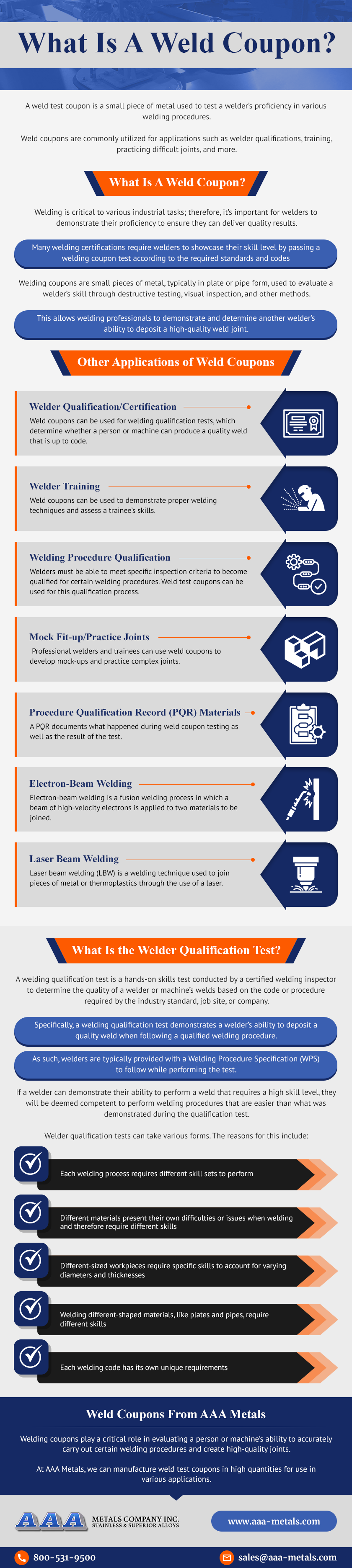
A weld test coupon is a small piece of metal used to test a welder’s proficiency in various welding procedures. Weld coupons are commonly utilized for applications such as welder qualifications, training, practicing difficult joints, and more. Here, we will dive into the specifics of weld coupons and their different applications, as well as the purpose of welder qualification tests.
What Is a Weld Coupon?
Welding is critical to various industrial tasks; therefore, it’s important for welders to demonstrate their proficiency to ensure they can deliver quality results. Many welding certifications require welders to showcase their skill level by passing a welding coupon test according to the required standards and codes.
Welding coupons are small pieces of metal, typically in plate or pipe form, used to evaluate a welder’s skill through destructive testing, visual inspection, and other methods. This allows welding professionals to demonstrate and determine another welder’s ability to deposit a high-quality weld joint.
Other Applications of Weld Coupons
Weld coupon testing is ideal for various applications, including:
Welder Qualification/Certification. Weld coupons can be used for welding qualification tests, which determine whether a person or machine can produce a quality weld that is up to code.
Welder Training. Weld coupons can be used to demonstrate proper welding techniques and assess a trainee’s skills.
Welding Procedure Qualification. Welders must be able to meet specific inspection criteria to become qualified for certain welding procedures. Weld test coupons can be used for this qualification process.
Mock Fit-up/Practice Joints. Professional welders and trainees can use weld coupons to develop mock-ups and practice complex joints.
Procedure Qualification Record (PQR) Materials. A PQR documents what happened during weld coupon testing as well as the result of the test.
Electron Beam Welding. Electron-beam welding is a fusion welding process in which a beam of high-velocity electrons is applied to two materials to be joined.
Laser Beam Welding. Laser beam welding (LBW) is a welding technique used to join pieces of metal or thermoplastics through the use of a laser.
What Is the Welder Qualification Test?
A welding qualification test is a hands-on skills test conducted by a certified welding inspector to determine the quality of a welder or machine’s welds based on the code or procedure required by the industry standard, job site, or company. Specifically, a welding qualification test demonstrates a welder’s ability to deposit a quality weld when following a qualified welding procedure. As such, welders are typically provided with a Welding Procedure Specification (WPS) to follow while performing the test.
If a welder can demonstrate their ability to perform a weld that requires a high skill level, they will be deemed competent to perform welding procedures that are easier than what was demonstrated during the qualification test.
Welder qualification tests can take various forms. The reasons for this include:
Each welding process requires different skill sets to perform.
Different materials present their own difficulties or issues when welding and therefore require different skills.
Different-sized workpieces require specific skills to account for varying diameters and thicknesses.
Welding different-shaped materials, like plates and pipes, require different skills.
Each welding code has its own unique requirements.
Weld Coupons From AAA Metals
Welding coupons play a critical role in evaluating a person or machine’s ability to accurately carry out certain welding procedures and create high-quality joints. At AAA Metals, we can manufacture weld test coupons in high quantities for use in various applications, including qualification tests, recalibrating robotic welders, training/practice, and more. Using grinders, we can create weld coupons with specific angles that can be used to practice and perform welding tests at difficult angles.